
At G Square Clinic Skin, Hair and Plastic Surgery in Hubli, Dr. Girishkumar M. Chalawadi, Chief Dermatologist, provides personalised care for hair loss and hair-restoration concerns. His official profile highlights a special interest in hair disorders and trichology, while the clinic's website also features hair-transplant and hair-restoration care.
1. Protect Your Hair Grafts During Early Recovery
The first days after a hair transplant are particularly important.
Follow the exact postoperative instructions provided by your treating doctor. Depending on the procedure, you may be advised to use a recommended sterile spray or solution to prevent excessive dryness and support early scalp healing.
During this period:
- Do not scratch or pick the transplanted area.
- Avoid rubbing the grafts.
- Avoid direct trauma to the scalp.
- Use only products recommended by your doctor.
- Avoid strong water pressure over newly transplanted grafts.
Postoperative protocols can vary considerably between surgeons and techniques, which is why the treating doctor's instructions should take priority over generic online advice.
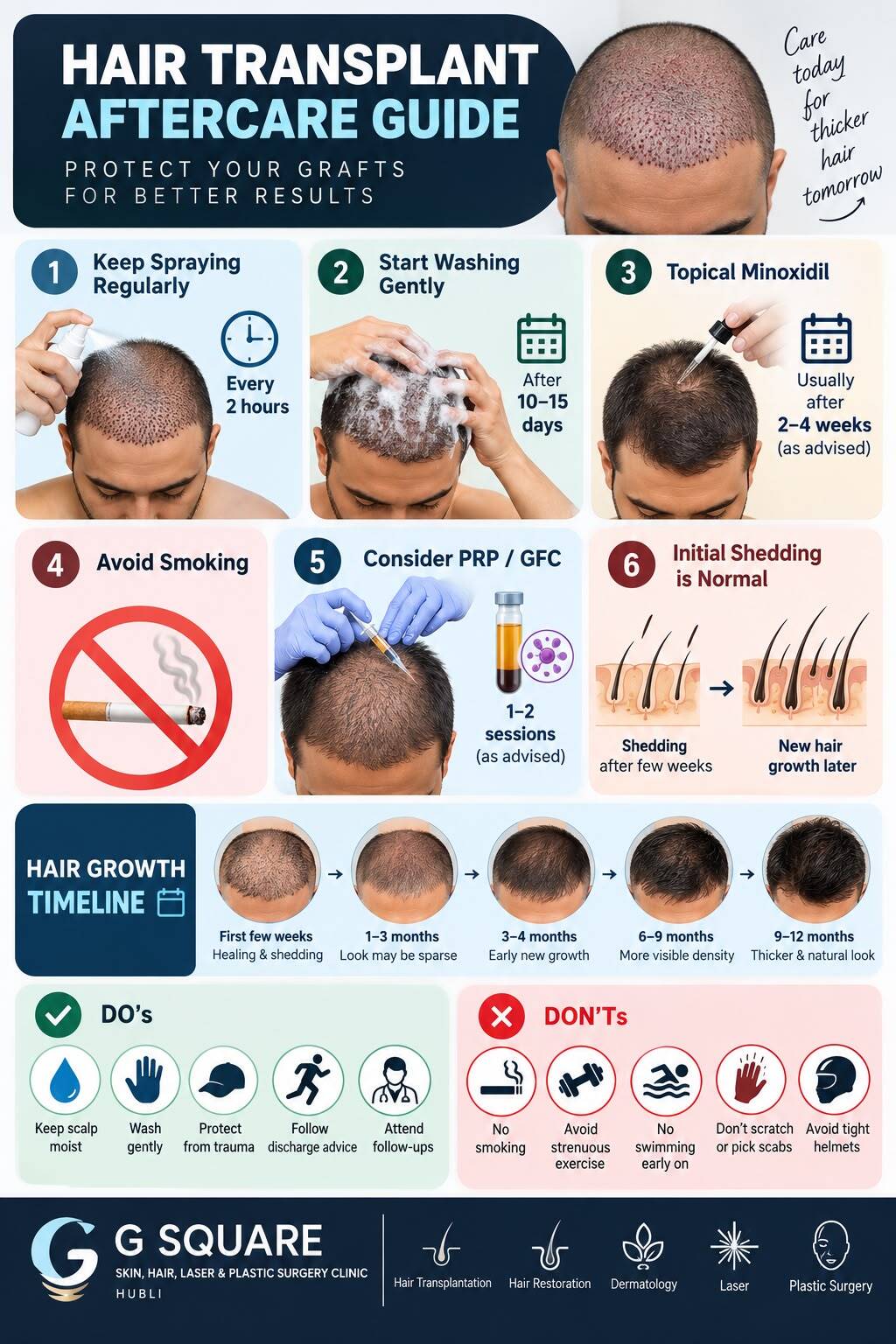
2. Wash Your Hair Gently
One of the most common Google searches after transplantation is “When can I wash my hair after a hair transplant?”
There is no universal day that applies to every patient. Washing protocols vary according to the transplant technique and surgeon.
When normal washing is permitted, the key is to be gentle:
- Use the recommended shampoo.
- Avoid vigorous rubbing or scratching.
- Do not deliberately pick off crusts.
- Avoid forceful shower pressure initially.
- Pat rather than aggressively rub the scalp.
Follow-up is useful because the washing technique can be gradually adjusted as healing progresses.
3. Don't Panic About Hair Shedding
Seeing transplanted hairs fall out can be worrying, but early shedding does not automatically mean the graft has failed.
After transplantation, the visible transplanted hair shafts may shed while follicles remain within the scalp and enter a resting phase. Literature describes transplanted hairs commonly shedding in the weeks following surgery, with new growth beginning after a resting period of around three months.
A simplified recovery timeline may look like:
First few weeks: Healing, crusting and shedding may occur.
1–3 months: The transplanted area may temporarily appear thin.
Around 3–4 months: Early new hair growth may begin.
6–9 months: Density and thickness gradually become more noticeable.
9–12 months and beyond: Further maturation and cosmetic improvement may continue.
Results and timelines vary between individuals.
4. Minoxidil After a Hair Transplant
Patients frequently search for “when to start minoxidil after hair transplant.”
Minoxidil may be useful for selected patients, particularly when androgenetic alopecia continues to affect existing non-transplanted hair. However, postoperative medication should be restarted only when your treating doctor advises it.
Hair-transplant guidelines emphasise that medical treatment often remains important because transplantation does not stop the underlying progression of androgenetic hair loss.
Do not restart minoxidil simply because a fixed number of days has passed—timing should reflect your healing and treatment plan.
5. Avoid Smoking During Recovery
Smoking is best avoided around hair-transplant surgery and during healing.
Hair-transplant practice guidelines recommend reducing smoking before surgery and state that stopping completely is safer.
Following your surgeon's advice regarding smoking, alcohol, exercise, swimming, helmets and strenuous activity can help protect the healing scalp.
6. PRP or GFC After Hair Transplant
Some patients may be advised to undergo PRP or GFC treatment after a hair transplant as part of an overall hair-restoration programme.
These treatments should be considered adjuncts—not replacements for a properly performed transplant or appropriate treatment of continuing hair loss.
Whether PRP/GFC is appropriate, when it should be performed and how many sessions are required should be decided individually by your dermatologist.
7. Continue Treatment for Existing Hair Loss
A hair transplant redistributes follicles; it does not necessarily stop future thinning of your existing native hair.
This is why long-term management can be just as important as transplantation itself.
Depending on the individual, a dermatologist may recommend:
- Topical treatment such as minoxidil
- Other medical hair-loss treatment where appropriate
- PRP/GFC in selected cases
- Scalp and hair-care measures
- Regular photographic and clinical follow-up
Indian hair-transplant guidelines specifically emphasise counselling patients that transplantation should not be regarded as a one-step permanent solution for progressive androgenetic alopecia.
8. Regular Follow-Up Matters
Post-transplant follow-up allows your doctor to assess:
- Scalp healing
- Graft recovery
- Crusting or irritation
- Hair shedding
- New hair growth
- Continued native-hair thinning
- Need for maintenance treatment
- Any unexpected symptoms or complications
Most importantly, do not judge your final hair-transplant result during the first few weeks or months. Hair growth is a biological process and takes time.
Hair Transplant Aftercare: Golden Rules
💧 Protect the grafts and use sprays only as advised.
🧴 Wash gently according to your doctor's protocol.
✋ Never scratch or pick transplanted grafts or crusts.
💊 Restart minoxidil only when advised.
🚭 Avoid smoking during recovery.
💉 Consider PRP/GFC only when recommended.
🍂 Expect some early shedding—it can be part of normal recovery.
⏳ Be patient because visible new growth takes months.
👨⚕️ Attend scheduled follow-ups with your treating doctor.
Book a Hair & Hair Transplant Consultation in Hubli
Searching for hair transplant aftercare in Hubli, hair loss treatment near me, hair transplant recovery advice, PRP/GFC treatment or a hair specialist in Hubballi?
Consult Dr. Girishkumar M. Chalawadi at G Square Skin, Hair & Plastic Surgery Clinic for personalised hair-loss and post-procedure guidance.
📞 Call G Square Clinic: +91 91106 10004 👈
💬 Book an Appointment on WhatsApp 👈
🌐 Visit G Square Skin, Hair & Plastic Surgery Clinic 👈
📚 Read Skin, Hair & Dermatology Blogs 👈
📍 G Square Skin, Hair & Plastic Surgery Clinic
First Floor, Shriya Lakshmi Business Centre,
Besides New Court, Behind Hosur Bus Stand,
Hubli – 580021, Karnataka. The phone number, email and clinic address are currently listed on the official website.
📍 Get Directions to G Square Clinic on Google Maps 👈
Dr. Girish Kumar M. Chalawadi
Dermatologist | G Square Skin, Hair & Plastic Surgery Clinic